Popular searches


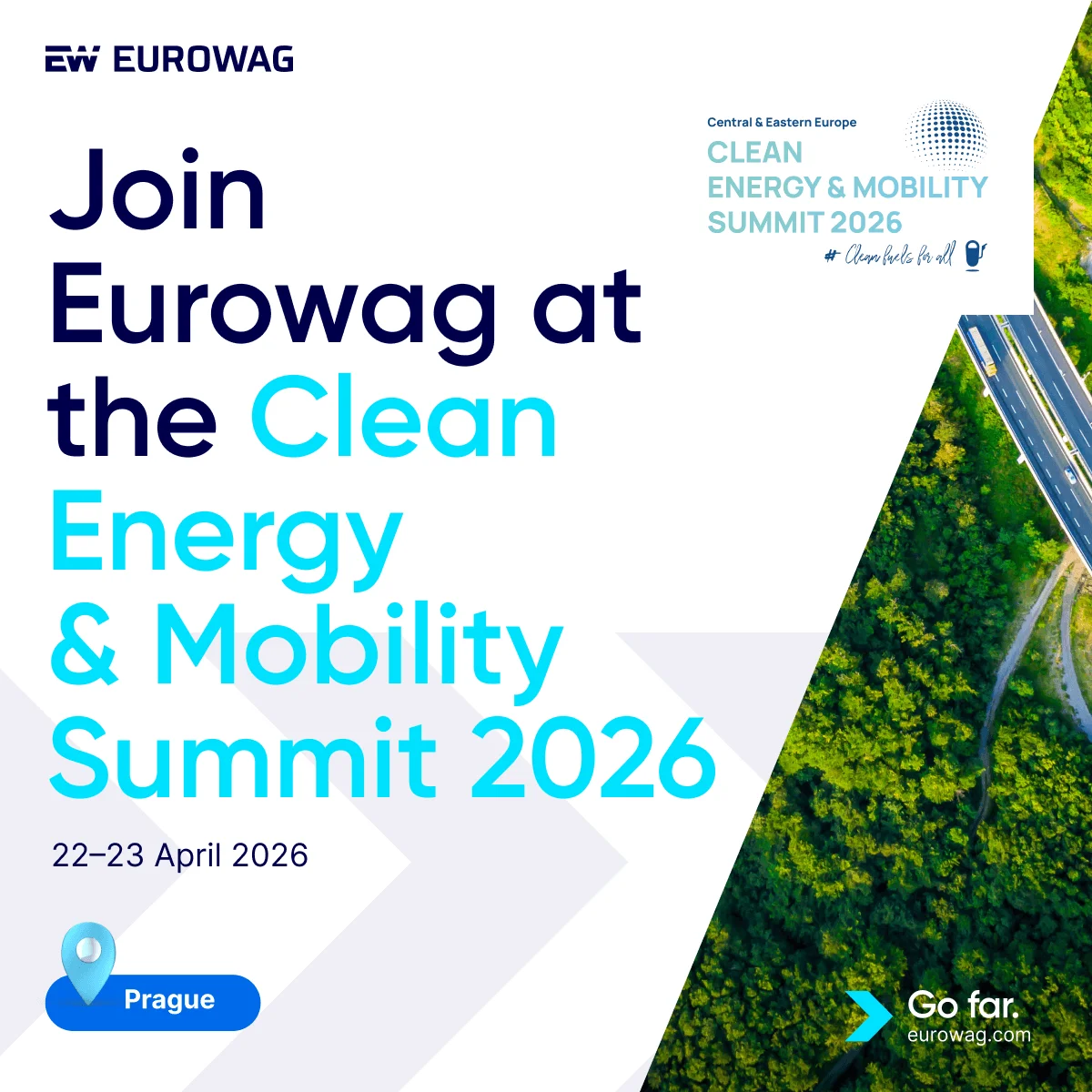
These challenges will be discussed at the CEE Clean Energy & Mobility Summit 2026 in Prague. Eurowag is the event’s general partner.
.webp)
Prague, April 21, 2026 – Transport companies across Europe are committed to cutting emissions, but say rising costs, complex rules and a lack of infrastructure are slowing progress. Industry players warn that uneven conditions between Western and Central and Eastern Europe could lead to a “two-speed” decarbonization, giving companies in more developed markets a competitive advantage. These insights are based on a survey by Eurowag among its customers in the commercial road transport (CRT) sector across Europe.
The findings come as the European Commission steps up efforts to decarbonize road transport through a series of regulatory measures, including stricter CO₂ emission standards for heavy-duty vehicles and expanded reporting requirements under EU sustainability rules.
According to the survey, carriers see decarbonization as a top priority and an essential factor for maintaining future competitiveness. At the same time, they point out a growing gap between rising expectations to reduce emissions and the economic conditions required to make the transition viable.
“Transport companies are under growing pressure to reduce emissions, driven by both customer demand and regulatory requirements. However, for many of them, the transition to low-emission solutions is financially and operationally very demanding. Ultimately, unless decarbonisation is profitable, it cannot hope to scale,”
says Martin Vohánka, Founder and CEO of Eurowag.
The challenging situation is also highlighted by ČESMAD Bohemia, representing Czech carriers:
“Czech transport companies do not reject decarbonization. However, the key lies in the operational characteristics of zero-emission vehicles. There are not yet enough suitable contracts. In practice, they also face significant obstacles—high initial costs for zero-emission vehicles, insufficient infrastructure, and uncertainty regarding future regulations. If conditions in Europe are not uniform, the question is which group of countries the Czech Republic will fall into. It may happen that companies in Central and Eastern Europe lose their competitiveness compared to Western markets,”
says Vojtěch Hromíř, Secretary General of ČESMAD Bohemia.
Data from the European Automobile Manufacturers’ Association (ACEA) show that zero-emission vehicles still represent only a fraction of the market. In 2024, more than 15,000 electric trucks and around 170 hydrogen-powered trucks were registered in the EU, accounting for roughly 0.25% of the total fleet. In 2025, more than 12,800 new electric trucks were registered, representing 4.2% of all registrations.
Diesel trucks still account for over 95% of heavy-duty vehicles in every European country. The strongest growth in electric truck adoption has been recorded in countries such as the Netherlands, Germany, and France.
Significant differences also exist in the energy mix. Central and Eastern European countries remain more dependent on fossil fuels, with a lower share of renewable energy compared to Western Europe, which started investing earlier. This makes the transition to clean mobility more complex and costly.
“An uneven pace of decarbonization risks creating significant competitive imbalances. Transport operators in more developed markets may gain a clear advantage, while companies in CEE region face a more complex and costly transition,”
says Matthias Maedge, Eurowag’s Vice President for CRT Decarbonization.
These structural challenges and the need to balance climate ambition with economic reality will be at the centre of discussions at the CEE Clean Energy & Mobility Summit 2026 in Prague. The event will bring together industry leaders and policymakers to explore pragmatic pathways to decarbonisation, including the role of decarbonised fuels alongside electrification.
Details about the program and registration for the event can be found on the conference’s official website CEE Clean Energy & Mobility Summit 2026.
Eurowag (the operating name of W. A.G. Payment Solutions) is a leading pan-European integrated platform for payments and mobility focused on the commercial road transport sector. Eurowag enables transport companies to successfully transition to a low-carbon digital future by leveraging all critical data, insights, payment, and financial transactions within a single ecosystem and connecting their operations before, during, and after every trip. Eurowag offers more than 2,000 alternative fuel stations, including over 700 HVO fuel stations, as part of its network of more than 17,000 stations.
Zuzana Kacanova,
Eurowag
+421 917 973 655