GTM debug

Eurovignette in 2026: What fleet managers need to know
Clock
Reading time:6
Calendar
3.6.2026

Eurovignette in 2026: What fleet managers need to know

Quietest change in European road tolling last year: CO2 emission classes went into Eurovignette pricing in March 2025. Two Euro VI trucks lined up at the same border can now be quoted noticeably different daily rates depending on which of the five new CO2 bands they land in, and VECTO-certified low-emission stock gets a real break on the annual rate.

That's the biggest thing a fleet manager needs to get their head around for 2026. There's also the matter of the scheme getting smaller. Denmark pulled out on 1 January 2025, the Netherlands follows on 1 July 2026, and that drops the Eurovignette country list to Luxembourg and Sweden by the middle of this year. But the CO2 update is the one that hits the budget spreadsheet, and it's the one worth understanding first.

What is the Eurovignette?

Generally, the Eurovignette is a time-based vignette. Fleet managers know it better as a period licence that covers HGV motorway use in whichever countries are still signed up to the original 1994 Eurovignette Treaty. You pay for a chunk of time, a day, a week, a month or a year, and the truck runs those motorways freely for the duration. Whether that's one calendar day before a ferry or twelve months of daily Benelux crossings, the rate's fixed by the window, not by the kilometres. A tractor that sits in the yard four days out of seven pays the same Eurovignette rate as one running Malmö to Luxembourg and back every working day.

  • The scheme runs under the Eurovignette Directive, originally Directive 1999/62/EC, amended several times, most recently by Directive (EU) 2022/362.
  • That Directive covers most of what you'd expect: weight thresholds that put a truck into scope, the way CO2 classes are supposed to be applied, the interface with EETS, and a few other bits besides.
  • The 2022 amendment is the one that forced the CO2 piece into the original signatories' pricing by March 2025.

Most fleets these days buy through eurovignettes.eu or through a toll-service provider that handles it alongside everything else. A few service stations near participating borders still sell them, though that route is shrinking year on year. Either way, once the vignette is paid, the vehicle's number plate is in the system. No hardware, no sticker in the windscreen, no driver paperwork at the border.

Which countries use the Eurovignette in 2026?

The Eurovignette countries in 2025 were Luxembourg, Sweden, the Netherlands and (until New Year's Day) Denmark. That number has been dropping for years as individual members turned away to the distance-based HGV toll systems run through on-board units, and it drops again in the middle of 2026. For fleets planning 2026 routing, the countries still inside the scheme are:

Denmark left on 1 January 2025 and now operates a distance-based toll administered through Sund & Bælt, with a CO2 component already baked into the rate. The Netherlands has confirmed its own exit for 1 July 2026. From that date, Dutch motorway use for HGVs will be charged through the Vrachtwagenheffing, a per-kilometre scheme run via approved EETS providers and a national settlement body. After 1 July 2026, the Eurovignette covers Luxembourg and Sweden only.

For fleets that regularly operate into or through the Netherlands, don't leave the July 2026 switch until June. Picking an OBU provider takes time. Getting tractors activated on the Dutch network takes more. Then there's the data feed into fleet reporting.

How the 2025 CO2 class update changed Eurovignette pricing

March 2025 brought the biggest pricing change in years. CO2 emission classes were bolted onto the Eurovignette fee structure.

Under the old model, your Eurovignette rate was set by two things: the vehicle's number of axles and its Euro emission class (Euro II, Euro III, up through Euro VI). Cleaner engines paid less. That’s still true. What’s changed is that CO2 performance now sits on top of that calculation.

How the five CO2 classes work

There are five CO2 classes.

  • Class 1 is the default, anything not certified for a lower-emission category lands here.
  • At the other end, Class 5 is where zero-emission trucks sit: battery-electric or hydrogen fuel-cell.
  • Classes 2, 3, and 4 sit in between, based on the vehicle’s certified CO2 performance against a reference vehicle in the same category.

Certification comes through the EU's VECTO system, and the class has to be recorded at the point of purchase.

What this means for your fleet budget

At any given border crossing, two Euro VI trucks can now be pulling noticeably different Eurovignette prices out of the system. Same engine standard, different CO2 class. Newer fleets with certified low-emission vehicles have a slight edge. Older Euro VI stock, common in subcontracted haulage, doesn’t qualify for a discount and pays the full Class 1 rate.

Rates change. Not often, and usually not by much, but enough to matter if the tolls line on the budget is built off last year's numbers. The current fee schedule lives on eurovignettes.eu and is worth a proper read before any spend gets signed off. For a 2026 ballpark, an annual Eurovignette on a Euro VI Class 1 tractor with four or more axles lands in the low-to-mid four figures, with cleaner CO2 classes coming in below that. For occasional cross-border runs rather than a weekly schedule, the daily and weekly tickets will usually work out cheaper anyway.

Which trucks need a Eurovignette?

Eurovignette trucks are heavy goods vehicles used for commercial goods transport on designated motorway networks in participating countries. Historically that has meant vehicles with a maximum permissible gross weight of 12 tonnes or more, though the 2022 Directive amendments have cleared the way to extending the coverage to some vehicles over 3.5 tonnes as national implementations roll out.

If it's a rigid, a tractor unit, or a drawbar combination above the weight threshold, it's in scope. Cars and light vans stay outside. So does any vehicle not used for commercial goods transport.

Before assuming you need one, check the specific network each country covers. In Luxembourg, the charge applies to the A-road motorway network. In Sweden, it applies to the main E-routes. Driving outside those networks doesn’t automatically require a Eurovignette, but if your routes involve any participating country’s motorways, you need one.

How to buy a Eurovignette for your fleet

You have three realistic routes.

Buy through a toll service provider

For fleets of any real size, this is the default option. Your provider takes care of purchasing and renewal, runs the reporting, and rolls payment into whatever you already pay them for European tolls. Your ops team stops chasing expiry dates every Friday. It also puts the Eurovignette on the same monthly statement as your other road charges, which makes reconciliation simpler.

Eurowag’s toll management for fleets covers the Eurovignette alongside OBU-based tolls across Europe in a single consolidated account.

Buy direct through eurovignettes.eu

The central booking portal lets you buy daily, weekly, monthly, and annual vignettes for individual vehicles. It works well for a single truck or a small fleet. Manually purchasing and renewing dozens of vignettes across staggered expiry dates is where the admin cost starts to bite.

Buy at designated sales points

Some service stations near borders and inside participating countries still sell Eurovignettes, though this option is shrinking as the system digitises.

Eurovignette, EETS and OBU: what are they?

This is where fleet managers get confused. These terms can overlap and the industry chucks them around without much clarity.

  • The Eurovignette is time-based. Pay for a window: day, week, month, year, and you're covered. No box in the cab, nothing to install. The vignette is simply attached to the number plate.
  • An OBU (on-board unit) is a small electronic device installed in the cab. It records distance travelled on tolled roads and bills you per kilometre. Most of the EU runs distance-based tolling through OBUs now: France, Germany, Austria, Italy, the Iberian Peninsula, Czechia, and so on. Each country historically ran its own OBU. That has been changing with EETS.
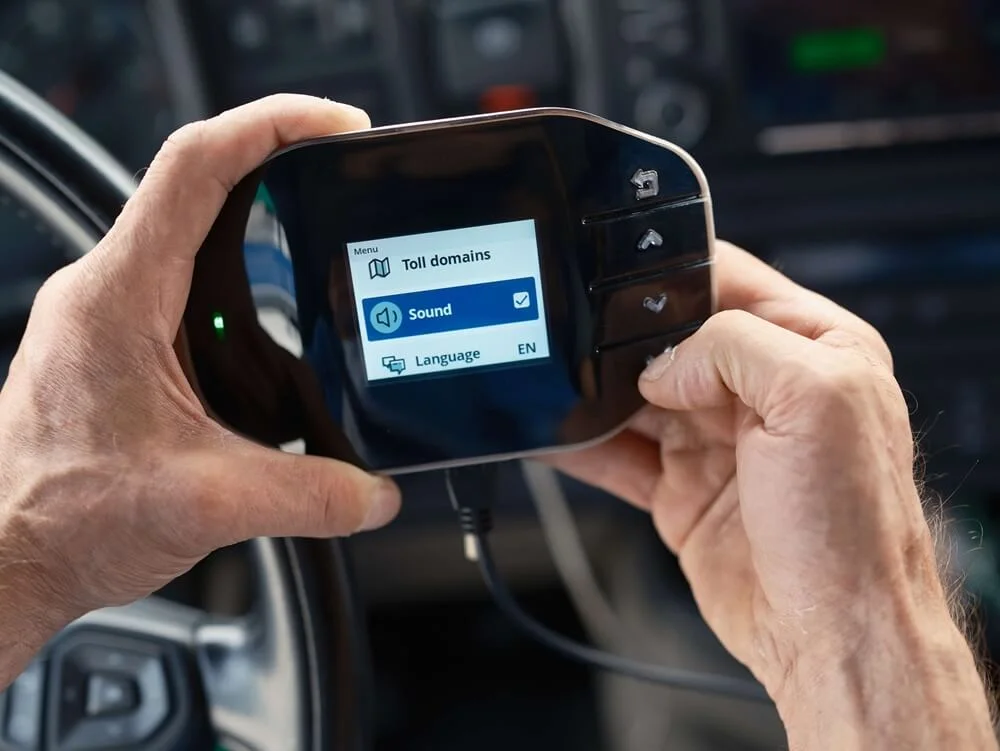
  • EETS (European Electronic Toll Service) is the EU framework that lets a single OBU from an approved provider work across multiple member states. For a fleet running routes across several countries, one EETS-compliant OBU replaces a drawer full of national devices and cuts the admin of managing different accounts with each national toll operator. Eurowag’s EVA OBU is an EETS-compliant device covering most tolled networks in Europe.

Do you need both a Eurovignette and an OBU? If your routes cross between time-based and distance-based countries, yes. Until the Netherlands switches over in July 2026, a fleet running Benelux to Germany to Austria pays Eurovignette in NL and OBU-based tolls in DE and AT on the same trip.

Frequently Asked Questions

What is the difference between the Eurovignette and a regular road toll?

Short version: the Eurovignette is paid for by time, not by distance. Buy a week, a month, or a year, and the truck runs as much as it wants on the participating motorways inside that window. Standard European tolls work the other way round, they're distance-based, with the OBU in the cab metering kilometres and billing per trip. Most of the continent has moved to that model, which makes the Eurovignette something of a holdout. Luxembourg, Sweden, and (until mid-2026) the Netherlands are the three countries still running it.

Which countries currently use the Eurovignette?

Three at the moment: Luxembourg, Sweden, and the Netherlands. Denmark was in until 31 December 2024 and left on New Year's Day 2025. The Netherlands goes the same way on 1 July 2026, which leaves just Luxembourg and Sweden by the back half of the year.

How has Eurovignette pricing changed in 2025?

CO2 emission classes were added to the pricing structure in March 2025. Rates now depend on axle count, Euro emission class, and CO2 class. Cleaner vehicles pay less. The CO2 class has to be certified through the EU’s VECTO system and recorded when buying the vignette.

How do I buy a Eurovignette for my fleet?

You can buy through the eurovignettes.eu portal, at designated sales points, or through a toll service provider. For fleets of more than a few trucks, a service provider is almost always more cost-effective once admin time is factored in.

Can an OBU replace the Eurovignette?

Not in the participating countries today. The Eurovignette is a time-based charge and has to be bought separately, even if your truck already has an EETS-compliant OBU for other European tolls. That will change as participating countries migrate to distance-based systems. The Netherlands’ 2026 switch is the clearest example.

Does the Eurovignette apply to vans and light commercial vehicles?

Not under the current thresholds. It applies to heavy goods vehicles used for commercial goods transport, typically 12 tonnes maximum permissible gross weight and above. The 2022 Directive amendments cleared the path to expanding scope to vehicles over 3.5 tonnes, but the timing of that expansion varies by country.

Download our latest e-books

Cover of guide titled Safe truck parking in Europe with person in yellow vest and blue cap smiling.
Safe truck parking in Europe. A Practical Guide for Transport Professionals.
Eurowag cover on tablet with trucks on highway and text about money in transport business.
Money lies on the route - How not to miss it when running a transport company?
Man with folded arms stands in front of a truck on a driver behavior coach ebook cover.
Driver behavior coach - Turn everyday driving into a saving machine