Beliebte Suchen


Die Kräfte verstehen, die die Dekarbonisierung des gewerblichen Straßentransports prägen – und die verfügbare Unterstützung, um den Übergang zu bewältigen.
Matthias Maedge, Vice President CRT Decarbonisation, Eurowag
Eurowag hat kürzlich eine Umfrage unter seinen Kunden im gewerblichen Straßengüterverkehr (CRT) in ganz Europa durchgeführt, um die wichtigsten Hindernisse und Motivatoren für die Dekarbonisierung des Sektors zu untersuchen. Zwei der wichtigsten Ergebnisse waren, dass unsere Kunden:
Wir wissen, dass diese Ansichten oft den Druck widerspiegeln, dem CRT-Unternehmen von ihren eigenen Kunden ausgesetzt sind – die sie dazu drängen, Emissionseinsparungen zu erzielen. In vielen Fällen wird dies durch die Corporate Sustainability Reporting Directive (CSRD) vorangetrieben, die größere Versender und Transportkäufer dazu verpflichtet, indirekte Emissionen in der Wertschöpfungskette (Scope 3) zu melden. Dies führt wiederum zu einem Druck auf CRT-Unternehmen, ihre eigenen direkten Emissionen (Scope 1) zu reduzieren, da Versender für kombinierte Verkehre und Binnengütertransporte überwiegend auf Straßentransportdienstleistungen angewiesen sind.
Eurowag liegt dieses Thema sehr am Herzen. Wir setzen uns entschlossen für die Dekarbonisierung des Sektors ein – weil sie für die Gesundheit unseres Planeten notwendig ist – und übernehmen eine führende Rolle bei diesem Wandel. Gleichzeitig engagieren wir uns gleichermaßen für die langfristige Wettbewerbsfähigkeit unserer Kunden und für einen florierenden CRT-Sektor, ohne den keine moderne Wirtschaft überleben kann.
Aus den täglichen Gesprächen mit unseren Kunden wissen wir zudem zwei weitere wichtige Dinge:
Erstens ist der regulatorische Kontext für viele CRT-Unternehmen verwirrend. Und zweitens sind die Hürden für den Umstieg auf emissionsärmere Fahrzeuge und Kraftstoffe für Unternehmen, die bereits unter Druck stehen und mit geringen Margen arbeiten, entmutigend.
Dieser Blog soll beide Punkte adressieren – er wird:
Eine der Herausforderungen für unsere gesamte Branche besteht darin, dass es mehrere europäische Rechtsvorschriften gibt, die das operative Umfeld im Hinblick auf die Dekarbonisierung prägen. Hier sind die wichtigsten:
Dies wirft zwei zusammenhängende Fragen auf: Zeigt diese Gesetzgebung die gewünschte Wirkung? Sind wir auf dem richtigen Weg, um die auf europäischer Ebene angestrebten Ziele zu erreichen?
Die kurze Antwort auf beide Fragen lautet: „Nein“.
Im Mai 2025 veröffentlichte die Europäische Kommission eine Mitteilung zur „technologischen und marktbezogenen Einsatzbereitschaft von schweren Nutzfahrzeugen“ (COM/2025/260 final).
Sie lieferte eine nützliche – wenn auch wenig ermutigende – Momentaufnahme unseres aktuellen Standes beim Übergang zu emissionsfreien Fahrzeugen im gewerblichen Straßengüterverkehr. Sie zeigte, dass im Jahr 2024:
Dies deutet zwar auf Wachstum hin – ein deutliches Wachstum im Vergleich zu den Vorjahren –, doch der Anteil emissionsfreier Lkw bleibt äußerst gering.
Die verfügbaren Daten unterstreichen den aktuellen Stand. Das Volumen des Straßengüterverkehrs ist in den letzten 15 Jahren um 20 % gestiegen, während die Treibhausgasemissionen ebenfalls zugenommen haben – wenn auch langsamer. Wir machen Fortschritte, aber nicht genug:

Dennoch blicken Lkw-Hersteller optimistisch auf den Ausbau des emissionsfreien Segments. Sie teilten der Europäischen Kommission mit , dass bis 2030 etwa jedes dritte neue schwere Nutzfahrzeug emissionsfrei sein könnte – was die Flotte emissionsfreier Fahrzeuge auf 410.000 bis 600.000 Einheiten (5–9 % der Flotte schwerer Nutzfahrzeuge) anwachsen ließe. In einem kürzlich an die Präsidentin der Europäischen Kommission, Ursula von der Leyen, gerichteten Schreiben äußerten sie jedoch Zweifel und forderten eine „Kurskorrektur“.
Selbst die Kommission ist skeptisch gegenüber diesen Schätzungen. Die Mitteilung besagt: „Auch wenn die Preise für emissionsfreie schwere Nutzfahrzeuge in den kommenden Jahren voraussichtlich sinken und die TCO [Gesamtbetriebskosten] deutlich günstiger werden, wäre dies ein starker Marktanstieg in sehr kurzer Zeit in einem Markt, der durch geringe Gewinnspannen, viele KMU-Betreiber mit begrenztem Investitionskapital und einen sehr geringen Anteil an emissionsfreien Fahrzeugen im Jahr 2025 gekennzeichnet ist.“
Wir bei Eurowag sind der Ansicht, dass die Kommission zu Recht skeptisch gegenüber den erwarteten Marktprognosen ist, diese spiegeln jedoch den Druck wider, unter dem die OEMs stehen, um den Übergang voranzutreiben. Und selbst wenn es sich um Überschätzungen handelt, besteht kein Zweifel daran, dass der Wandel kommt – und zwar schnell.
Eurowag betreut mehr als 30.000 Transportunternehmen als aktive Kunden, daher ist es unsere Aufgabe, den Druck, unter dem sie stehen, und die Herausforderungen, denen sie gegenüberstehen, zu verstehen. Für uns ist es keine Überraschung, dass die Einführung von emissionsfreien Lkw und der Ausbau der notwendigen Infrastruktur langsamer verlaufen als geplant – denn der Umstieg auf alternative Energien ist für die meisten Unternehmen im gewerblichen Straßengüterverkehr keine leichte Entscheidung.
Wir wissen, wie wettbewerbsintensiv und preissensibel die Branche ist. Wir verstehen, wie groß jede Lkw-Anschaffung ist und wie sorgfältig die Gesamtbetriebskosten (TCO) kalkuliert werden. Wir wissen daher, wie schwierig es für die meisten Unternehmen ist, einen E-Lkw in Betracht zu ziehen, wenn der Anschaffungspreis mehr als doppelt so hoch ist wie bei einem Diesel-Lkw (ganz zu schweigen von einem Wasserstoff-Lkw, der noch teurer ist).
Wir verstehen auch die Bedenken hinsichtlich des begrenzten Ladenetzes bzw. der Tankstelleninfrastruktur, insbesondere auf Langstrecken.
Wie immer gibt es solche und solche – aber nicht genug verstehen die Lage. Deshalb klärt Eurowag politische Entscheidungsträger in ganz Europa auf, damit sie die Realitäten unserer Branche verstehen. Unser Ziel ist es nicht, die Dekarbonisierungsagenda zu verlangsamen. Im Gegenteil: Wir wollen die Interessen unserer Kunden vertreten, indem wir politischen Entscheidungsträgern helfen, Maßnahmen zu formulieren, die in der Praxis eine realistische Chance auf Erfolg haben.
Am wichtigsten ist, dass wir auf die Herausforderungen hinweisen, die durch politische Inkohärenz entstehen. Während beispielsweise RED III und CountEmissions EU einen Lebenszyklusansatz für Emissionen vorschlagen, konzentrieren sich die CO₂-Emissionsnormen für schwere Nutzfahrzeuge ausschließlich auf die Auspuffemissionen, was alternativen Kraftstoffen faktisch die Tür verschließt. Diese Inkonsistenz widerspricht dem Prinzip der Technologieoffenheit und könnte den Fortschritt bei der Dekarbonisierung verlangsamen. Die Europäische Kommission muss zudem davon absehen, Gewinner und Verlierer zu bestimmen, und marktgesteuerten Lösungen ermöglichen, zu gleichen Bedingungen zu konkurrieren.
Diese Probleme stellen eine besondere Bedrohung für Mittel- und Osteuropa (MOE) dar, das eine führende Rolle im internationalen Straßengüterverkehr spielt. Tatsächlich befinden sich vier der fünf führenden europäischen Länder im internationalen Güterverkehr in Mittel- und Osteuropa, was etwa 250.000 Unternehmen entspricht.
Im März dieses Jahres nahm Eurowag eine führende Rolle beim Fuel Congress 2025 in Warschau ein, bei dem Vertreter aus ganz Mittel- und Osteuropa einen gemeinsamen Aufruf zum Handeln an die Europäische Kommission unterzeichneten. Der Aufruf zum Handeln wurde inzwischen von mehr als 30 Organisationen in ganz Europa unterstützt und an die Kommissionspräsidentin Ursula von der Leyen gesendet. Eurowag arbeitet zudem aktiv mit Fleet Cards Europe (FCE) zusammen, einem in Brüssel ansässigen Handelsverband, der das Tankkartengeschäft vertritt, in sehr engem Kontakt mit Straßentransportunternehmen steht und deren Interessen wahrnimmt. FCE ist Teil des Network for Sustainable Mobility (NSM), einer informellen Koalition gleichgesinnter Akteure, die die Europäische Kommission dazu auffordert, den Rechtsrahmen anzupassen.
Neben anderen politischen Prioritäten setzt sich Eurowag für Folgendes ein:
Wenn Sie mehr über die Interessenvertretung von Eurowag erfahren oder uns in diesem Bereich unterstützen möchten, nehmen Sie bitte Kontakt mit uns auf.
Angesichts militärischer Konflikte und zunehmender Unsicherheiten bei der Energieversorgung hat sich in den letzten Monaten die Diskussion über die Zukunft des europäischen Green Deal und des kürzlich vorgestellten Clean Industrial Deal intensiviert. In bestimmten Bereichen nehmen einige einen Wandel im Ton der Europäischen Kommission wahr – eine Verschiebung hin zu mehr Pragmatismus, wenn nicht sogar zu einer Abschwächung der Ambitionen.
Doch die Richtung für den Transportsektor ist bereits vorgegeben. Die Gesetzgebung steht, und die Fristen sind fixiert. Die Fahrzeughersteller mobilisieren ihre Kräfte, um ihre eigenen Ziele zu erreichen.
Unternehmen machen sich etwas vor, wenn sie glauben, dass die Dekarbonisierungswelle an ihnen vorbeizieht. Sie kommt, und sie wird den gesamten Sektor verändern.
Wer jetzt reagiert, indem er auf Elektrofahrzeuge setzt und Diesel durch dekarbonisierte Kraftstoffe ersetzt – also handelt, bevor er keine andere Wahl mehr hat –, wird sich kurzfristig einen Wettbewerbsvorteil verschaffen und langfristig seine Zukunftsfähigkeit sichern.
Wer nicht reagiert, geht ein enormes Risiko ein.
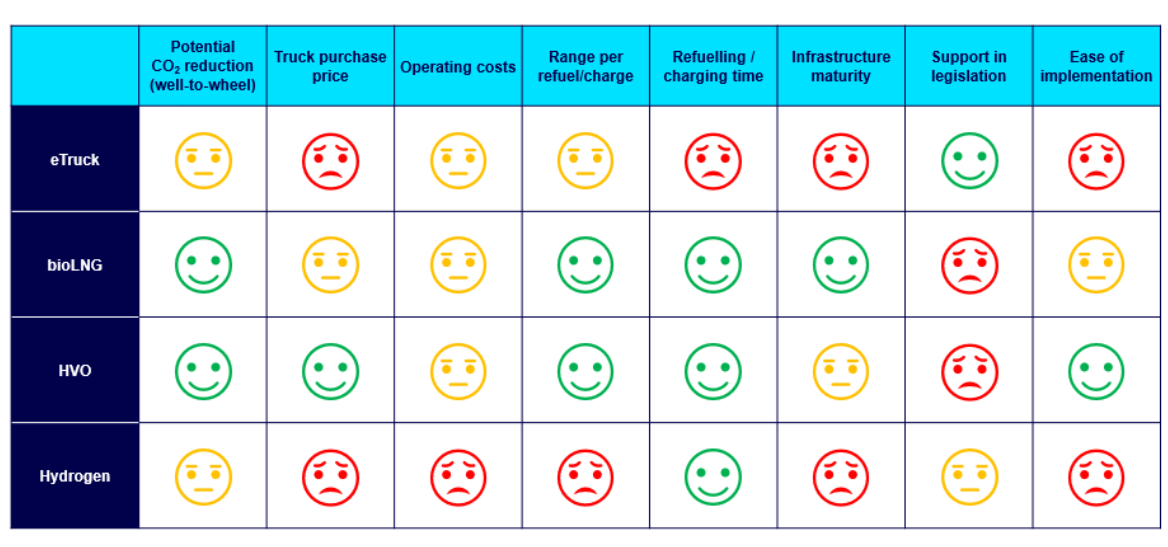
Unterschiedliche Technologien und Kraftstoffe eignen sich für verschiedene Transportarten – der Stadt- und Regionalverkehr unterscheidet sich stark vom internationalen Fernverkehr –, und die richtige Wahl für jedes Unternehmen hängt von mehreren Faktoren ab.
Hier sind die vier Optionen für alternative Kraftstoffe:
1. HVO (hydriertes Pflanzenöl) ist ein Drop-in-Kraftstoff, was bedeutet, dass Transportunternehmen ihre CO2 -Emissionen mit ihrer aktuellen Flotte reduzieren und ihn ohne Einschränkungen in Dieselmotoren verwenden können. Die bevorzugten Rohstoffe für die Herstellung von HVO sind tierische Fettabfälle oder Altspeiseöle, die eine CO2 -Reduktion von bis zu 90 % auf Basis der gesamten Wertschöpfungskette (Well-to-Wheel) ermöglichen.
HVO ist die schnellste und einfachste Lösung, um eine signifikante Emissionsreduzierung zu erreichen. Der Preis liegt derzeit 10–25 % über dem von Diesel, aber die Beliebtheit nimmt zu, während die Dieselpreise allmählich steigen werden.
2. Verflüssigtes Biomethan und komprimiertes Biomethan bieten eine CO₂-Reduktion von bis zu 100 % im Vergleich zu herkömmlichem Diesel. Biomethan gewinnt im Schwerlastverkehr stark an Bedeutung und ist bereits an über 30 % der europäischen LNG-Tankstellen verfügbar – mit weiter steigender Tendenz.
Bio-LNG-Lkw können zudem mit einer Tankfüllung mehr als 1.500 km zurücklegen, und der Umstieg auf Bio-LNG kann die Betriebskosten im Vergleich zu Diesel um über 30 % senken. In Deutschland ist es beispielsweise aufgrund des Treibhausgasminderungsquoten-Systems sogar günstiger als Diesel. Es wird erwartet, dass weitere Länder solche Treibhausgasquoten einführen, um die REDIII-Ziele zu erfüllen.
3. E-Lkw werden von den politischen Entscheidungsträgern der EU bevorzugt, da sie lokal emissionsfrei sind. Mittlerweile sind bereits rund 40 E-Lkw-Modelle auf dem Markt erhältlich. Dank weniger beweglicher Teile lassen sich zudem Wartungskosten einsparen.
Mit dem Ausbau des E-Ladenetzes in Europa und der zunehmenden Verfügbarkeit von Subventionen in immer mehr Ländern werden E-Lkw für Transportunternehmen zu einer immer attraktiveren Option – insbesondere für solche, die auf die letzte Meile, den Regionalverkehr sowie regelmäßige Punkt-zu-Punkt-Verbindungen im Mittel- und Langstreckenbereich spezialisiert sind.
4. Wasserstoff ist in Brüssel aus demselben Grund beliebt: Es handelt sich um eine Technologie ohne Auspuffemissionen. Zudem lassen sich Wasserstoff-Lkw in etwa der gleichen Zeit betanken wie Diesel-Lkw, was einen erheblichen Vorteil gegenüber der eMobilität darstellt.
Wasserstoff wird langfristig einen großen Einfluss auf die Branche haben, insbesondere wenn die Verfügbarkeit und das Tankstellennetz weiter ausgebaut werden. Die Technologie befindet sich jedoch noch in einem frühen Entwicklungsstadium und ist daher derzeit noch unerschwinglich teuer.
Eurowag unterstützt seine Kunden auf vielfältige Weise bei der Bewältigung der Dekarbonisierung:
Dekarbonisierung als Dienstleistung
Immer mehr Transportunternehmen suchen nach einem vertrauenswürdigen und kompetenten Partner, der sie bei diesem Wandel begleitet, die Einhaltung gesetzlicher Vorschriften sicherstellt und ihnen hilft, ihre Wettbewerbsfähigkeit in einem sich wandelnden Markt zu behaupten. Das Angebot „Decarbonisation as a Service“ (DaaS) von Eurowag ist ein ganzheitlicher Ansatz, um Kunden beim Übergang zur Klimaneutralität zu unterstützen und ihre Zukunftsfähigkeit zu sichern.
Dies umfasst:
Das Akzeptanznetzwerk für alternative Kraftstoffe wird kontinuierlich erweitert, um der wachsenden Nachfrage gerecht zu werden. Aktuell umfasst es:
Im Jahr 2024 wurde Eurowag zum ersten eMobilitäts-Dienstleister in Europa, der sich vollständig auf die Straßengüterverkehrsbranche konzentriert. Neben dem Zugang zu einem umfassenden Netzwerk von Ladestationen für Lkw und Transporter in ganz Europa umfassen unsere eMobilitäts-Dienstleistungen:
Wir bauen zudem das dedizierte Ladenetzwerk für Schwerlastfahrzeuge weiter aus und unterstützen Kunden mit integrierten Flotten- und Ladedienstleistungen, einschließlich der Mitfinanzierung und Vermarktung an Depots und entlang der Strecke (öffentlich zugänglich).
Die Bedeutung von Daten beschränkt sich natürlich nicht nur auf die eMobilität. Über das gesamte Spektrum alternativer Kraftstoffe hinweg gehen wir über den reinen Infrastrukturzugang hinaus, um das zu liefern, was den Wandel wirklich vorantreibt: verlässliche Nachhaltigkeitsdaten, die intelligentere Entscheidungen ermöglichen.
Unsere Plattform bietet Flottenbetreibern und Logistikunternehmen die Möglichkeit, Emissionen in Echtzeit zu verfolgen, die tatsächlichen Auswirkungen von Routen- und Kraftstoffentscheidungen zu bewerten und fundiert zu berichten – gestützt auf präzise, unabhängig verifizierte Daten. Von der Erfüllung von CO₂-Berichtstandards bis hin zum Nachweis von Fortschritten bei den Nachhaltigkeitszielen der Kunden: Eurowag trägt dazu bei, dass jeder Ladevorgang, jede Betankung und jede Route ein Schritt in Richtung messbarer Dekarbonisierung ist.
Der Sektor für gewerblichen Straßentransport tritt in eine entscheidende Phase ein. Die gesetzlichen Rahmenbedingungen stehen, die Infrastruktur wird ausgebaut und die Erwartungen von Partnern, politischen Entscheidungsträgern und Endkunden steigen rasant. Die Richtung ist klar: Die Zukunft gehört den alternativen Energien.
Es geht längst nicht mehr nur darum, Risiken zu vermeiden. Ein frühzeitiger Umstieg kann Kosten senken, neue Geschäftsmöglichkeiten erschließen und Ihre Vorreiterrolle in einer kohlenstoffarmen Wirtschaft unterstreichen. Je früher Sie handeln, desto stärker wird Ihre Position auf dem Markt von morgen sein.
Warten Sie nicht, bis der Wandel erzwungen wird. Lassen Sie sich von Eurowag dabei unterstützen, ihm einen Schritt voraus zu sein.
Vereinbaren Sie noch heute einen – und machen Sie den ersten Schritt in eine sauberere und wettbewerbsfähigere Zukunft.