Popular searches


On 26–27 May 2026, Eurowag representatives Piotr Żółty and Mateusz Włoch took part in discussions within the framework of CORTE, bringing together authorities and industry observers to address current and upcoming challenges in road transport enforcement activities.
The first day focused on a live demonstration of coordinated roadside inspection. Eurowag representatives joined other international observers and had the opportunity to follow officers during an active control operation.
The session provided valuable insight into how such procedures are conducted in practice, including the use of specialised equipment and digital tools supporting operational activities. The process highlighted the efficient use of the TachoScan Control system in real conditions.
The second day was dedicated to a summary of the inspection activities and presentations from enforcement authorities and government representatives.

Both the Police and the Ministry of Transport presented their operational approaches, with a strong focus on the IT systems currently in use and the challenges linked to their fragmentation. A key issue raised was the lack of system integration, including the absence of a unified login across different platforms. Participants also highlighted practical difficulties, such as translation issues within the IMI system, which continue to affect cross-border cooperation.
It was also noted that the Ministry already uses Eurowag’s solution to verify transport documentation against tachograph data using TachoScan Control.
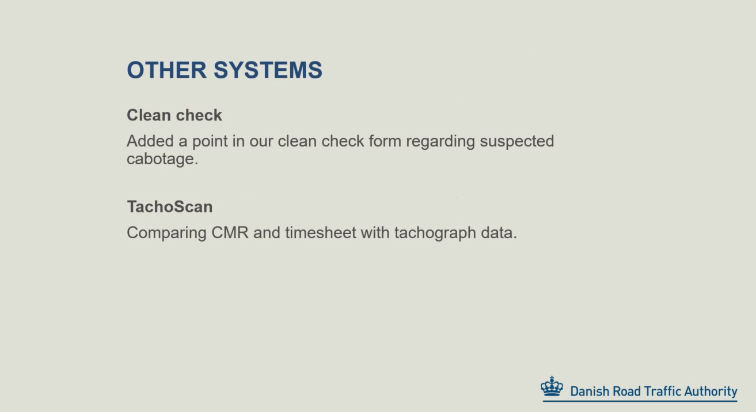

A particularly interesting presentation delivered by the Danish Police focused on advanced enforcement topics. These included the detection of vehicles with manipulated exhaust after-treatment systems, which result in increased emissions, as well as challenges related to GNSS signal integrity, including interference and jamming detection.
Another topic discussed was tachograph calibration and speed verification. It was highlighted that discrepancies can occur between the speed recorded by the tachograph and the actual vehicle speed. In some cases, deviations exceed acceptable tolerances, with vehicles travelling at approximately 93 km/h while recording 90 km/h.
A significant part of the discussions was dedicated to upcoming requirements related to driving time and tachograph obligations for light commercial vehicles, which will apply from 1 July 2026.
Participants reviewed draft guidance addressing the most frequently asked questions, particularly regarding the scope of application – clarifying which transport operations fall under the new rules and which are exempt. Special attention was given to complex cases such as escort vehicles in abnormal transport operations, where interpretations still differ between national enforcement authorities.
The discussions also covered the requirement to present records covering the previous 56 days. According to the draft guidance, from 1 July 2026 drivers will be required to carry complete activity records, including manual entries from the tachograph. For example, during a roadside inspection on 10 July, a driver must be able to present records covering at least the previous 10 days.
It was also clearly emphasised that the deadline of 1 July 2026 for the introduction of tachograph requirements for vehicles above 2.5 tonnes remains unchanged. Vehicles operating without a required tachograph after this date will be subject to penalties. This point was highlighted due to ongoing uncertainty in the market and assumptions that the timeline might still change – no such changes are planned.
Eurowag’s participation in the CORTE discussions reflects its continued commitment to supporting industry dialogue and contributing practical expertise to the development of more consistent, transparent and effective enforcement practices across Europe.