Popular searches


On 28 January 2026, Fleet Cards Europe (FCE) brought together members of the European Parliament and industry leaders for a high-level debate on the decarbonisation of corporate fleets. Eurowag is a leading member of FCE, with Matthias Maedge, Eurowag’s Vice President for Commercial Road Transport (CRT) Decarbonisation, chairing FCE’s Sustainability Working Group. Held in the European Parliament building, the timing of the debate was particularly significant: negotiations on the EU’s Automotive Package had just commenced, while the Clean Corporate Vehicles initiative was beginning to take shape. In this evolving policy context, the discussion provided a timely opportunity to align political ambition with operational reality: to test assumptions, highlight real-world constraints and ensure that the transition of road transport strikes the right balance between environmental ambition and economic viability.
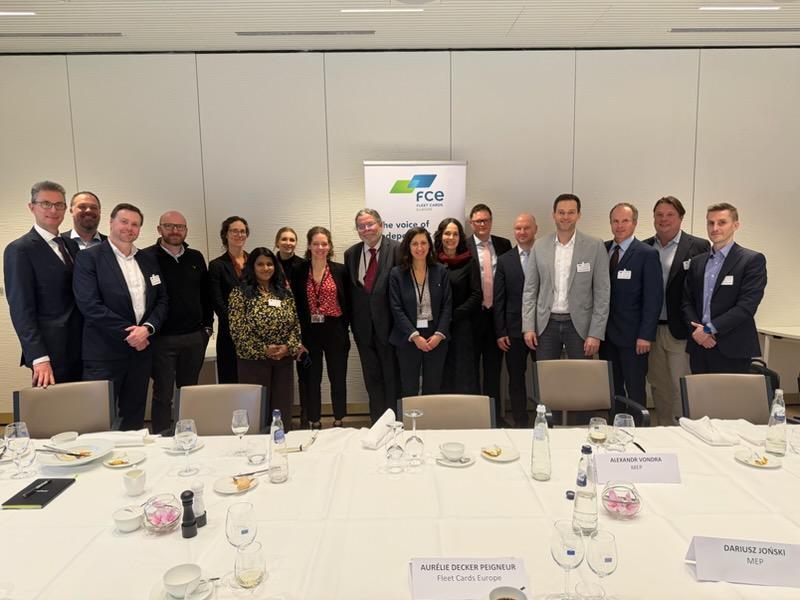
The debate was hosted by Czech MEP Alexandr Vondra, with contributions from two other members of the European Parliament: Miriam Lexmann from Slovakia and Kosma Złotowski from Poland. The Central and Eastern European (CEE) perspective was therefore well represented, highly appropriate given the region’s dominance of European CRT – and also because of CEE’s distinct transport realities and infrastructure challenges.

Alexandr Vondra MEP
(Czech Republic)
European Conservatives and Reformists Group
Alexandr Vondra is a member of the European Parliament’s Committee on the Environment, Climate and Food Safety (ENVI), and was the European Parliament’s rapporteur on the Euro 7 vehicle emissions proposal.

Miriam Lexmann MEP
(Slovakia)
Group of the European People's Party (Christian Democrats)
First elected in 2020, Miriam Lexmann serves on key committees including International Trade (INTA) and Employment and Social Affairs (EMPL). She has also engaged in discussions around the broader impacts of EU policy frameworks on transport and the green transition.

Kosma Złotowski MEP (Poland)
European Conservatives and Reformists Group
Kosma Złotowski has served on the European Parliament’s Committee on Transport and Tourism (TRAN) for more than 10 years, where he has been actively involved in legislative work concerning road transport, mobility rules and the functioning of the EU’s internal transport market.
The broader political landscape shaped much of the discussion. The Clean Corporate Vehicles initiative, the EU’s Fit for 55 package, the forthcoming Automotive Package and related climate legislation are collectively transforming how vehicles are manufactured, financed and operated across Europe. While the policy ambition is clear, implementation remains highly complex, particularly for commercial fleets navigating cross-border operations, diverse regulatory frameworks and the expansion of essential energy infrastructure.
Matthias Maedge opened the debate by stressing the distinctive position of fleet card providers in the transport ecosystem. Unlike many other stakeholders who operate at a strategic or regulatory level, FCE members maintain daily, data-driven relationships with fleet operators – from small and medium-sized enterprises (SMEs) to multinational logistics companies.
Also, fleet card systems today go far beyond fuel payments. They integrate telematics, emissions tracking, route optimisation, alternative fuel access and sustainability reporting. As a result, they generate real-time operational data that reveals not only emissions performance, but also cost pressures, infrastructure gaps and behavioural patterns – enabling detailed insight into how decarbonisation policies unfold in practice.
This operational intelligence is crucial, as it allows policy-makers to move beyond theoretical modelling and understand how regulatory decisions impact fleets navigating tight margins, driver shortages, cross-border compliance and evolving customer demands.
The discussion revealed encouraging areas of alignment between policy-makers and industry representatives:
Despite this shared ambition, participants were also open about the barriers to progress – with three primary challenges identified:

There are several reasons why this is so important for transport operators, particularly SMEs:
The dialogue in Brussels highlighted a fundamental truth: Europe’s decarbonisation goals will only be achievable if political ambition is matched by operational feasibility.
Legislative scrutiny of the Automotive Package will intensify in both the European Parliament’s Committee on the Environment, Climate and Food Safety (ENVI) and the Committee on Transport and Tourism (TRAN). Industry engagement during this phase will be critical. Policy-makers cannot adopt effective legislation unless they understand the technical constraints, investment timelines and regional disparities. At the same time, industry must continue to demonstrate its constructive commitment to reducing emissions.
FCE’s debate was an important step towards finding a constructive middle ground, helping to ensure that regulatory frameworks are evidence-based, consistent and firmly aligned with the realities of Europe’s road transport industry.
For Eurowag, participation in this forum reflected a broader strategic commitment: supporting fleets through the transition to a low-carbon and digital future. This involves not only providing integrated payment and mobility solutions, but also advocating for policy frameworks that are coherent, technology-neutral and practically implementable by the entire sector.
Decarbonising road transport is not a theoretical exercise. It’s happening daily – in depots, along motorways, at charging hubs and in operations centres, where fleet managers are battling to balance costs, compliance and customer expectations.
Our message to the MEPs in Brussels was clear: ambition is essential. Yet only by pairing ambition with a grounded understanding of real-world operations can Europe create a transport sector that is truly sustainable – both environmentally and economically.
.png)