Popular searches


Europe’s commercial road transport sector is undergoing decarbonisation, but progress differs significantly between Western Europe and Central & Eastern Europe due to infrastructure, financial, and policy gaps. This creates challenges for CEE operators and requires a more gradual, multi-solution transition approach.
.png)
In Eurowag’s recent article, Which Way to Turn: Navigating a Route to Net Zero, Matthias Maedge outlined a fundamental shift that is underway in Europe’s commercial road transport (CRT) sector: decarbonisation is no longer a distant ambition, it has become an immediate business priority.
But while the direction of travel is clear, the reality on the ground is far from uniform. In fact, a two-speed transition is emerging, one that highlights a growing divide between Western Europe and Central & Eastern Europe (CEE).
Understanding and addressing this gap will be critical to ensuring a fair, effective and economically viable transition.
Particularly in long-haul, heavy-duty transport, progress towards decarbonisation has been slow everywhere in Europe – but in most cases, Western European countries have advanced further and faster than CEE markets.
The most recent data from the European Automobile Manufacturers’ Association (ACEA) on truck registrations across Europe was published earlier this year. It reveals that, in 2024, diesel trucks still represented more than 95% of the heavy-duty fleet in every European country, with battery electric trucks comprising more than 2% in only two countries: Norway (2.1%) and Denmark (2.0%):

However, both in terms of progress away from diesel heavy-duty vehicles, and the adoption of battery electric trucks, the countries that have made the most progress are all in Western Europe.
This raises two questions:
There are three primary reasons why Western Europe is currently outperforming CEE when it comes to the adoption of lower-emission and zero-emission CRT vehicles: a) eMobility readiness; b) stronger access to capital; and c) earlier policy implementation.
One of the clearest points of divergence lies in infrastructure readiness.
Western Europe has made significant progress in building out charging networks and alternative fuel corridors. Germany is a notable example, having implemented two successful measures which make the country very interesting for electric and bioLNG trucks. First, it fully exempted electric trucks from paying tolls until 2031. Second, it has achieved the lowest European bioLNG prices via greenhouse gas quota trading and applied the Renewable Energy Directive (RED) to road transport for many years.
In CEE, however, charging infrastructure remains underdeveloped, with gaps in coverage and availability that make large-scale transition more difficult. At the same time, the greenhouse gas quota mechanism is only being implemented in most countries in 2026, which means that it will take time to reach more competitive bioLNG and bioCNG prices. (There is one competitive edge, however, as the fuel network for HVO is fairly well developed. Eurowag has actually developed the first connected HVO corridor across CEE countries.)
This creates a practical barrier to change. Fleet operators cannot confidently invest in new vehicle technologies without reliable access to charging infrastructure or competitive fuel prices. For many, the risk of operational disruption or under-utilised assets remains too high. As a result, the transition pathway in CEE is likely to be more gradual and more diverse than in Western European markets.
Rather than relying on a single solution, operators in CEE are increasingly adopting a mix of approaches, including sustainable renewable fuels such as HVO and bioLNG, which can deliver immediate emissions reductions over longer distances without requiring major infrastructure investments.
Decarbonisation is also a question of economics. Operators in Western Europe often benefit from stronger subsidy frameworks and more accessible financing for electric trucks that allow them to absorb the upfront costs.
In CEE, where most of the small and medium-sized companies are working on tight margins and operating over longer distances in international transport, the financial reality is different. Operators are already having to navigate significant cost pressures, including volatile fuel prices, rising tolls and increasing compliance costs. Adding the capital expenditure required for fleet transition can, for many, feel like an impossibility.
For this reason too, transitional solutions play a crucial role. They allow operators to reduce emissions today while maintaining flexibility for the future.
The situation is not absolutely consistent within these regions, but Western European member states have typically implemented European decarbonisation regulations more quickly and thoroughly than the member states in CEE. Also, the energy mix in CEE is much more fossil fuel dependent and the share of renewable energy is comparably lower than in Western European countries which started to invest in renewables much earlier. This is a structural problem in the region, but also provides great potential for further development.
The transposition of the third revision of the Renewable Energy Directive (‘RED III’) is a case study:
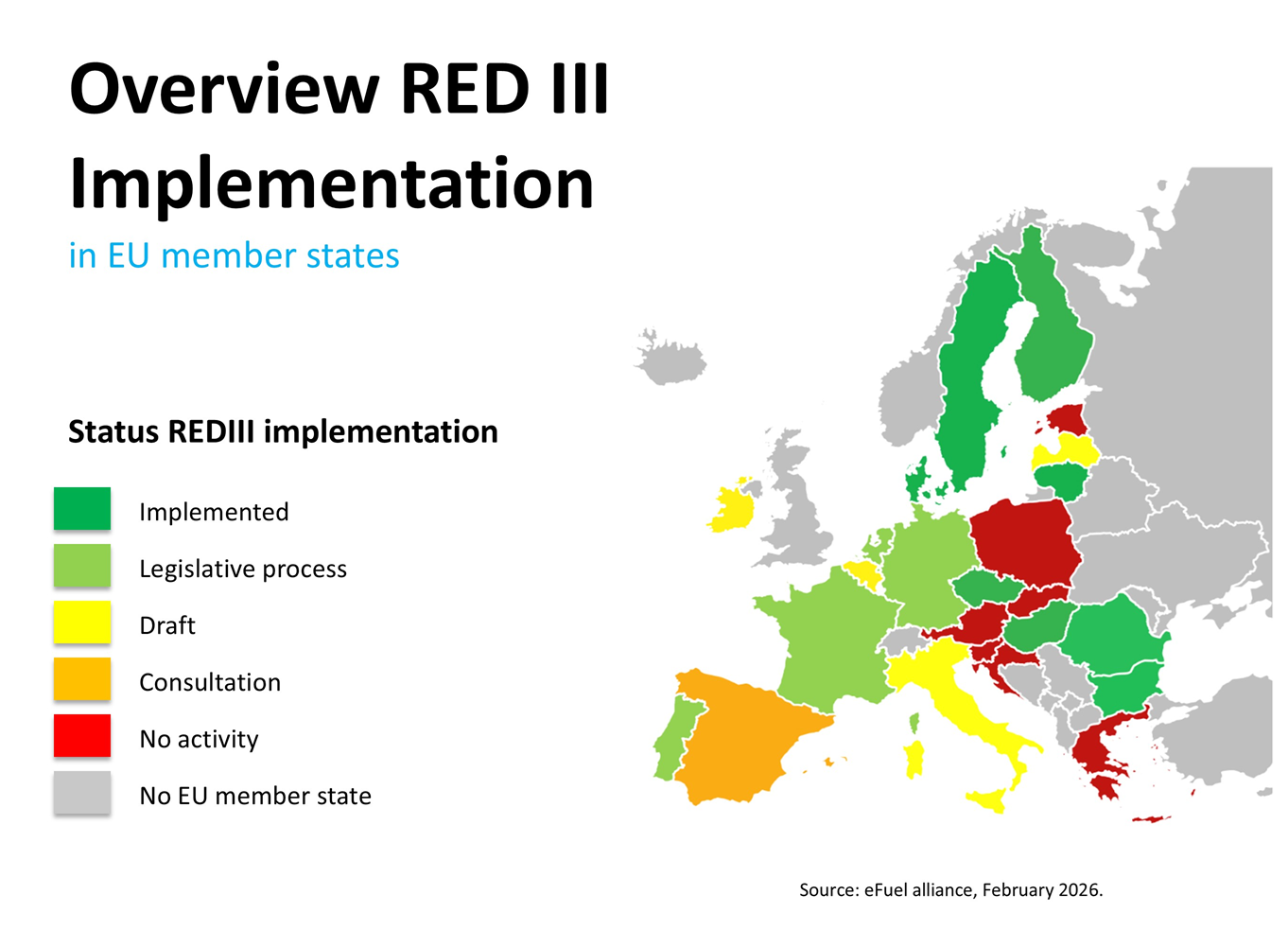
There are multiple factors behind the speed with which European decarbonisation legislation has been transposed across CEE, but it has been another brake on progress towards a more rapid adoption of low-emission vehicles in CRT.
Our second question was what impact this two-speed transition is having on CRT companies in CEE, where, as we have said, most of the sector is comprised of small and medium-sized firms operating on paper-thin margins.
Many of these companies are caught in an impossible bind. The pressure from customers and investors to reduce emissions is very real, but so are the barriers preventing them from taking the steps necessary to meet those needs.
Unless they do, they risk undermining their long-term competitiveness.
But if they do, they fear for their viability in the short-term.
This is not just a concern for CEE, because the region plays a vital role in Europe’s logistics ecosystem, acting as a key hub for cross-border transport and supply chains. Ensuring that operators in the region remain competitive should therefore be a European priority.
Yet the uneven pace of decarbonisation across Europe risks creating structural competitive imbalances. Operators in more advanced markets may gain a clear advantage, while those in CEE are left navigating a more complex and costly transition.
If not addressed, this could place additional strain on companies in CEE, ultimately affecting the efficiency and resilience of Europe’s wider transport network.
Policy-makers must strike a careful balance: maintaining a high level of ambition on decarbonisation, while recognising the very different starting points across Europe. Ensuring a level playing field will be critical – not only for fairness, but for the success of Europe’s decarbonisation efforts as a whole.
These challenges point to a clear conclusion: CEE cannot simply replicate a Western European model of decarbonisation at the same speed.
The region operates under different conditions – from infrastructure readiness and cost structures to market dynamics and investment capacity. As a result, its transition will inevitably follow a different trajectory: one that is likely to be more gradual, more flexible and more reliant on a mix of technologies and solutions.
Recognising this reality is not about lowering ambition. It is about ensuring that the transition is both effective and inclusive – enabling all parts of Europe to decarbonise at pace, without undermining competitiveness or cohesion.
To help us get to this point, it was necessary to create a platform for dialogue, a space where stakeholders can come together to share perspectives, align priorities and shape a pathway that reflects the realities of the CEE region.
This is exactly the role that the CEE Clean Energy & Mobility Summit 2026 aims to play.
Taking place in Prague on 22-23 April 2026, the summit will bring together policy-makers, industry leaders and energy experts from across the region to address the future of clean mobility in the CRT industry.
Hosted at the Grand Hotel Prague Towers, the two-day programme will feature keynote speeches, expert panels and networking opportunities aimed at promoting collaboration and driving progress.
The event will open with remarks from Karel Havlíček, Deputy Prime Minister of the Czech Republic and the Minister of Industry & Trade, alongside high-level contributions from European Union representatives, including Maja Bakran Marcich, Deputy Director-General of the European Commission’s Directorate-General for Mobility and Transport (DG MOVE).
Crucially, the summit will focus on the issues that matter most to CEE, including:
As the organisers have emphasised, the goal is to create “a much-needed space for open, fact-based discussion”. The conference will also aim to identify solutions that are not only environmentally sustainable, but economically viable for the CEE region.
For Eurowag, supporting the Summit is both a strategic priority and a natural step.
As a company with a strong presence in CEE, we understand the unique challenges facing operators in the region.
In addition, our mission has always been to simplify and support mobility for CRT customers, helping fleets operate efficiently while navigating an increasingly complex landscape. Today, that includes enabling decarbonisation in a way that is practical, scalable and economically sustainable.
Eurowag’s approach is based on pragmatism:
By supporting the CEE Clean Energy & Mobility Summit, Eurowag is helping to create a platform where these challenges can be addressed collectively and where solutions can be shaped together.
By recognising regional differences and by creating opportunities for dialogue and collaboration, the industry can move towards a more inclusive and effective transition.
The CEE Clean Energy & Mobility Summit 2026 represents a critical step in that journey.
It will be more than just an event. It will be an opportunity to define a shared vision for the region, one that ensures CEE has both a voice and a viable pathway in Europe’s decarbonised future.
For more details and to book your spot:
.png)