Popular searches


Road tolls and environmental sustainability are now directly linked. Across Europe, countries are restructuring their toll systems around CO₂ emission classes – a shift driven by EU Directive 2022/362 that significantly affects what your fleet pays per kilometre. This guide breaks down how the new CO₂-based truck tolls work and what rates apply in each major European country.

Introducing CO₂ emission classes into toll rates marks a pivotal shift in how European nations use economic tools to combat climate change. The system supports zero tailpipe emission vehicles (BEV, H2) while excluding alternative or renewable fuels. By linking toll charges directly to vehicle CO₂ emissions, the change aims to reduce environmental impact and accelerate the adoption of cleaner technologies.
This change stems from amendments to the Eurovignette Directive, originally adopted in 1999. The most recent revision – EU Directive 2022/362 – provides guidelines for incorporating environmental criteria into national toll pricing models. Member states can choose how to apply these criteria within their existing toll systems.
The 2022 reform obliges EU member states that levy truck tolls to comply with four key requirements:
The directive specifically targets heavy-duty vehicles, which are among the largest contributors to road transport emissions. By introducing tiered toll rates based on CO₂ emission class, it incentivises fleet upgrades to cleaner models. This integration of ecological considerations into the economic framework of road use marks a major regulatory shift for the EU.
The new toll structure is designed to minimise the CO₂ surcharge and environmental impact by adjusting fees based on emission levels. By directly linking toll rates to a vehicle's emissions, the system pushes operators to shift towards more sustainable transportation practices.
Revenue from these adjusted toll rates is typically reinvested into environmental and infrastructure projects. This funding supports a broader range of sustainability initiatives – from EV charging stations to public transport upgrades – helping to reduce the sector's overall carbon footprint.
European countries are revising toll structures to align economic activity with environmental goals. While each country's strategy reflects unique economic and political contexts, all share the common objective of using tolls to reduce carbon emissions.
These changes are often paired with public awareness campaigns and subsidies for green vehicle technologies, mitigating the cost impact on fleets. The combination of financial incentives and supportive policies creates a comprehensive strategy for encouraging sustainable transportation across the continent.
EU Directive 2022/362 mandates the integration of environmental standards into national toll systems. By linking toll rates directly to vehicle emission levels through e-toll systems, the directive leverages economic incentives to promote environmental responsibility among fleet operators.
Trucks with lower CO₂ emissions qualify for reduced toll rates under the new system. The structure rewards operators who invest in greener technology rather than simply punishing those who don't – a shift from enforcement to encouragement that aims to accelerate the adoption of clean technologies in commercial transport.
Revenue generated from CO₂ emission classes is typically reinvested into environmental sustainability projects, such as EV charging infrastructure and public transport networks. This redirects the cost burden placed on heavy polluters straight back into emission-reduction efforts, ensuring environmental impact is mitigated through both regulation and active investment.
Emission classes are ranked from 1 to 5: Class 1 = highest emissions, Class 5 = lowest. Each class corresponds to specific emission thresholds determined by the vehicle's technology and fuel type.
Older combustion-engine trucks typically fall into Classes 1 and 2. Newer models with advanced emissions control or alternative fuels (hybrid, electric, hydrogen) sit in Classes 4 and 5. This tiered system simplifies environmental impact assessment and helps regulators track emissions more effectively.
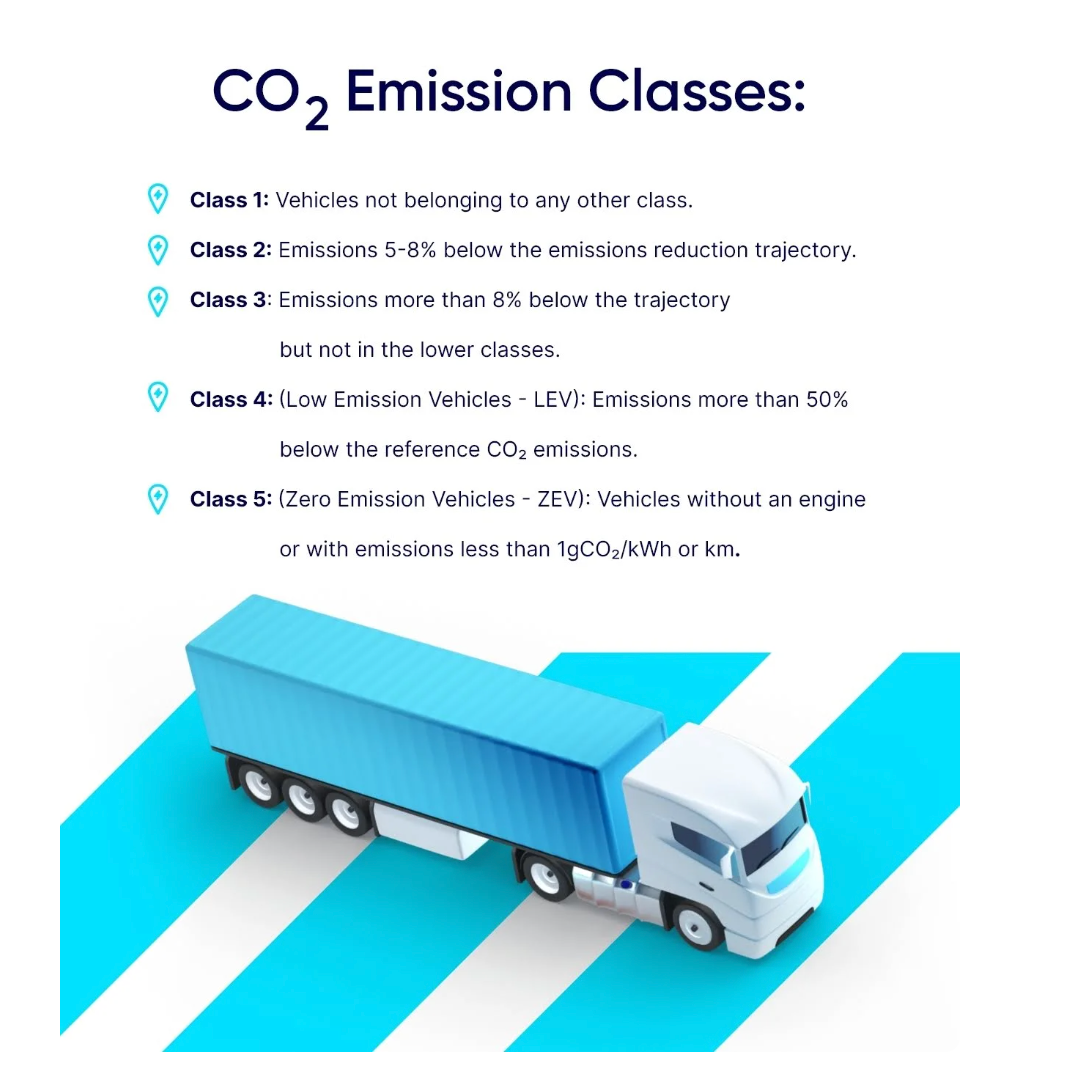
Toll rates are calculated based on each vehicle's CO₂ emission class and the emissions per kilometre it produces. The structure applies economic pressure on operators of higher-emission vehicles, nudging them towards more sustainable options.
The calculation also factors in total distance travelled, so environmental impact reflects both emission intensity and vehicle use. The system can be adjusted as policies evolve or new measurement technologies emerge, making it especially effective in dense urban areas where emission reductions have the biggest air quality impact.
Want to estimate the impact on your fleet? Use the free Eurowag CO₂ calculator to see how the new rules affect your routes.
This section breaks down how individual European countries have implemented CO₂ emission classes in their toll systems, including toll fee impacts and what they mean for fleet operators. You can also find in-depth country guides such as Spain and Romania on our blog.
Germany has aggressively integrated stringent CO₂ emission classes into its toll system, leading to a notable increase in toll rates for higher-emission vehicles. The German government complements these changes with subsidies for electric trucks and tax breaks for environmentally friendly logistics, easing the financial burden on truckers.
Pairing a digital fleet management solution with CO₂-aware route planning helps operators make the most of Germany's new tariff structure.
Austria has implemented a CO₂-based toll for vehicles weighing over 3.5 tonnes, with rates that increase progressively year-on-year. Revenue is invested in infrastructure that supports eco-friendly mobility solutions.
Austria uses a distance-based tolling system called the GO toll, applicable to HGVs over 3.5 tonnes – including lorries, buses, and large motorhomes. To access motorways and express roads, vehicles must be equipped with the GO box, a certified on-board unit that communicates with toll portals via microwave technology.
HGV operators can pay tolls in advance (pre-pay) or after travel (post-pay) via ASFINAG's GO Direkt service. A single Eurowag fuel card combined with EETS-compatible toll services simplifies cross-border operations between Austria and neighbouring countries.
Current per-kilometre tariffs (split into infrastructure, air & noise pollution, and CO₂ emissions components) are published by ASFINAG and updated annually. See the official rate tables for the latest figures.
Hungary's HU-GO electronic distance-based toll system applies to vehicles over 3.5 tonnes and is built around two main components:
Infrastructure Charge – covers construction, maintenance, operation, and development of tolled roads. Calculated based on road length, axle count (categories J2–J5), and road type. Specific rates are set by NFM Decree No 25/2013 (V. 31.).
Externality Charge – addresses the environmental costs of air and noise pollution and CO₂ emissions from road transport.
Detailed rates including VAT are published on the official HU-GO portal and updated annually.
Poland's truck tolling system varies between state and private operators, each applying different methods and rates. Charges typically depend on distance travelled, measured via an On-Board Unit (OBU) – though direct toll stations also exist on parts of the A2 (Poznan–Konin) and A4 (Katowice–Krakow).
Toll classifications are based on axle count and maximum allowed weight. Only the state operator categorises vehicles by pollutant class. Costs depend on vehicle weight, axle count, and pollutant class, and are indexed annually..
Rates differ between national roads of class A/S (motorways and expressways) and class GP/G (main roads). Current per-kilometre tariffs are published on e-TOLL and indexed annually.
For national roads of class A and S, or their sections, on which electronic toll is collected.
For national roads of class GP and G or their sections on which electronic toll is collected.
The Czech Republic has integrated CO₂ emissions into its toll system in line with EU Directive 2022/362.
All vehicles pay road use and noise pollution fees, but electric and hydrogen vehicles are not charged for air pollution or CO₂ emissions. All vehicles must be registered and equipped with the required onboard device. Vehicles up to 4.25 tons remain exempt but must still register and equip the device.
Any vehicle or combination over 3.5 tonnes in the Czech Republic must pay tolls (combinations count only towing vehicle weight). Toll rates are determined by axle count, emission class, road type, day of week, and time. Vehicles need the OBU 5051 on-board unit, with rates that depend on the same factors and are indexed annually..
A multi-country smart on-board unit can replace several national OBUs on routes covering Czechia, Slovakia, and Austria.
France has taken a more gradual approach, with moderately adjusted toll rates that give the trucking industry more time to adapt. This pace balances economic impact with environmental benefits.
Trucks over 3.5 tonnes on French motorways need an OBU compatible with the TIS PL system for seamless toll payments – or can pay manually at toll stations. The network is managed by multiple private concessionaires, each with their own pricing. Toll-free bypasses are available around major cities like Paris and Lyon.. Toll charges may also vary by direction, day, and time on certain road sections.
Belgium's road network is segmented into three regions – Flanders, Brussels, and Wallonia – each setting its own road taxes and charges. Toll rates depend on the vehicle's permissible weight (from 3.5 tonnes) and pollutant class, with cost calculated by distance via a Viapass on-board unit.
Motorway toll rates depend on vehicle type and are indexed annually. Driving in Brussels city centre is up to 50% more expensive than on the motorways.
Flanders and Brussels apply annual index adjustments to their tariffs. The Brussels-Capital Region extends a preferential rate of zero cents per kilometre to zero-emission vehicles (ZEVs) – aligning with the existing Flemish rate – though ZEVs still require an OBU. Wallonia also requires an OBU and classifies ZEVs under the EURO VI emissions category.
The new tariffs cover all HGVs and category N1 semi-trailer towing vehicles with body code BC – Belgian and foreign – with GVW over 3.5 tons. Rates apply across GVW categories (3.5–12 t, 12–32 t, 32+ t) and seven Euro emissions standards (Euro 0 most polluting to Euro 6 cleanest). The rate per kilometre is more favourable for vehicles with a higher Euro standard and lower GVW.
OBUs provided by Eurowag – including the EVA on-board unit certified for the kilometre charge in Belgium – update automatically to reflect new tariffs. Current rates are available on the Viapass website.
The Netherlands is undergoing the most significant toll reform in the region. Since 1 July 2026, the Eurovignette was abolished and replaced by a kilometre-based truck toll system aligned with frameworks already in place in Germany, Austria, and Belgium. Trucks over 3.5 tonnes will be charged per kilometre driven on motorways and selected national, provincial, and municipal roads – with rates linked to vehicle weight and CO₂ emission class.
Until 1 July 2026, trucks of 12 tonnes GVW or more still needed the Euro-Vignette to use the higher-level Dutch road network. After that date, the time-based vignette ends entirely – there is no transitional vignette option once the new system goes live.
The new system uses satellite-based toll collection via a GNSS-enabled on-board unit, which automatically transmits distance data to the toll service provider. Fleets with modern, low-emission vehicles will benefit from lower per-kilometre rates, while older or heavier trucks face higher charges. Cross-border operators are expected to adopt EETS solutions with one OBU and one consolidated invoice to manage Dutch tolls alongside other European systems.
Denmark left the Eurovignette system on 1 January 2025 and replaced it with a kilometre-based truck toll called KmToll. The new system applies to trucks of 12 tonnes GVW or more, with rates linked to distance driven, vehicle weight, and CO₂ emission class – directly aligned with EU Directive 2022/362.
The Danish government plans to extend the toll to trucks above 3.5 tonnes from 1 January 2027 and to the entire public road network from 1 January 2028. Until then, the toll covers approximately 10,900 km of state and selected municipal roads. Driving in environmental zones in Copenhagen, Frederiksberg, Odense, Aarhus, and Aalborg costs 50% more than other toll roads.
Toll is collected via an approved on-board unit from an EETS provider, or via a digital KmToll ticket purchased before the journey. Bridge tolls (Storebælt and Øresund) remain separate from KmToll and apply to all vehicles regardless of weight.
Trucks of 12 tons GVW or more need the Euro-Vignette to use motorways and toll roads in Luxembourg and Sweden. (Denmark left the system on 1 January 2025, and the Netherlands left on 1 July 2026 – see those sections.) The vignette covers all motorways for foreign-registered trucks (and the entire road network for local trucks) in Luxembourg, and major Swedish trunk roads including the E4, E10, E12, E14, E22, and E65.
The vignette is valid across all participating countries during its validity period, regardless of where it was purchased. Pricing depends on pollutant class, axle count, and validity period (from one day to one year). The Euro-Vignette is one of Europe's more economical toll options.
The Scandinavian approach has consistently used CO₂ emission classes to accelerate the shift towards zero-emission logistics. In Sweden, Class 5 trucks are eligible for toll exemptions in certain areas, further promoting green technology adoption.
In Switzerland and Liechtenstein, trucks over 3.5 tons are subject to tolls on all roads in both countries. Toll amount is based on vehicle weight, pollutant class, and driving distance, with rates published annually by the Swiss Federal Office for Customs and Border Security.. Distance is tracked via an on-board unit.
Evolving CO₂ regulations are shaping not only government policy but also strategic decisions by transport and logistics companies. Expecting further restrictions, fleet operators are increasingly investing in cleaner technology – driven by tax incentives for low emissions and higher tolls for vehicles that don't comply.
Digital tolling technologies enable more precise emission measurement and dynamic pricing. Future systems may use real-time data to adjust toll rates based on current environmental impact – potentially charging more during peak congestion or in high-pollution zones.
International collaboration on emission standards could lead to a more harmonised approach across borders, simplifying the regulatory environment for transnational logistics and ensuring a level playing field.
As public awareness of environmental issues grows, green credentials are becoming a competitive differentiator. Businesses now adapt to meet both regulatory requirements and consumer expectations – making CO₂ efficiency a strategic priority across the commercial transport landscape.
The introduction of CO₂ emission classes has reshaped European toll structures, aligning economic incentives with environmental goals. This shift supports cleaner transportation technology and sets a framework for sustainable operations across the continent.
The impact on local economies and global ecological efforts is profound, and CO₂-based tolling is no longer a regulatory trend but a core strategy for combating climate change. Continuous monitoring of these policies will be essential as toll systems evolve to meet new environmental and technological challenges.
Adapting to Directive (EU) 2022/362 means using technology that ensures both compliance and efficiency. Eurowag's European toll (EETS) solution, paired with the EVA on-board unit, delivers accurate vehicle classification and fair toll charges – supporting your 'go green' efforts in one package.
The EVA on-board unit captures CO₂ emissions data and toll payments in line with the directive's environmental aims. To estimate the financial impact, try the Eurowag CO₂ calculator – a smart way to plan ahead and keep your fleet rolling under the new regulations.
Ready to switch to a single toll solution for all of Europe? Get the EVA on-board unit and start saving on admin time and toll compliance.
Trucks are ranked from Class 1 (highest emissions) to Class 5 (lowest). Class 1 covers older combustion-engine vehicles, while Class 5 includes zero-emission trucks such as battery electric (BEV) and hydrogen-powered models.
Germany, Austria, Czechia, Hungary, Belgium, Poland, and Denmark have integrated CO₂ emission classes into their toll structures. The Netherlands is joining the group with its own kilometre-based system, and other EU member states are following progressively.
Partially. Brussels-Capital Region applies €0.00/km to zero-emission vehicles, and Czechia exempts electric and hydrogen trucks from air pollution and CO₂ charges (but not infrastructure or noise fees). Sweden also offers area-specific exemptions for Class 5 trucks.
Most countries apply tolls to vehicles over 3.5 tonnes GVW – including Austria, Czechia, France, Belgium, Switzerland, and the Netherlands. Denmark currently applies its kilometre-based KmToll from 12 tonnes, with the threshold lowering progressively. The remaining Euro-Vignette countries (Luxembourg, Sweden) apply tolls from 12 tonnes.
Each country has its own OBU requirements (GO box in Austria, OBU 5051 in Czechia, Viapass in Belgium, TIS PL in France). Eurowag's EVA on-board unit covers multiple European toll systems through a single device.
.png)

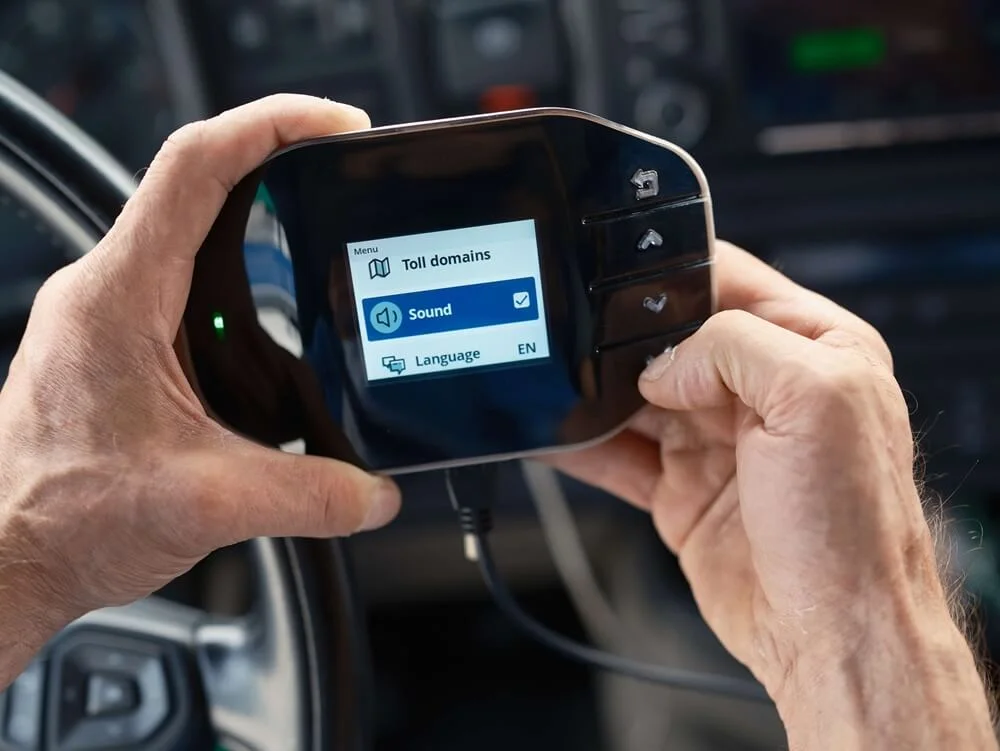
Stop juggling multiple toll systems. With a single EETS-certified OBU, you handle toll payments automatically, accurately and with every cost under control.